
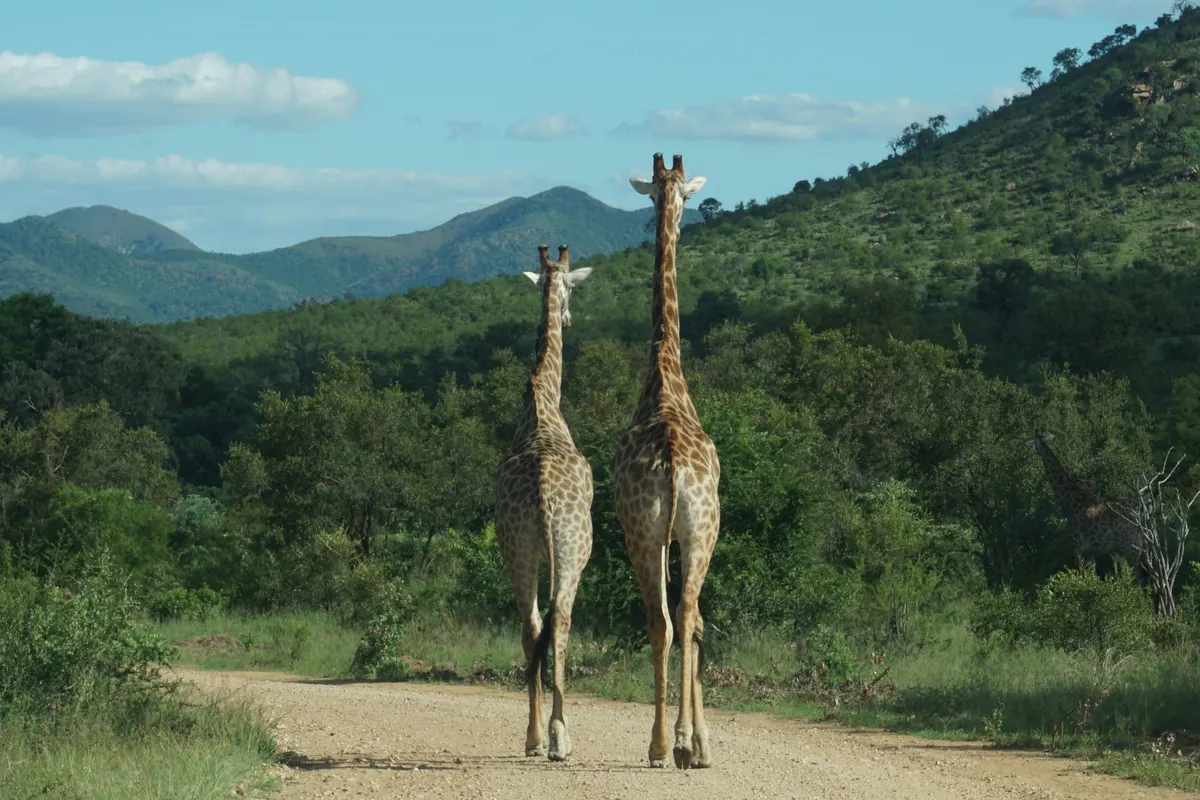
Kruger fees are simpler than most East African parks: one per-person rate, one currency, VAT already included. The work is in the counting. SANParks charges the conservation fee per night in the park, and the rate changes every year on 1 November. Get either wrong and the error repeats for every client on every night.
Every figure below comes from South African National Parks (SANParks), the park authority:
- the Kruger rates and entry fees page
- the general rates and entry fees page
- the 2025/26 conservation fee table (PDF) and the 2026/27 table (PDF)
- the conservation fee policy (PDF), dated 2011 and still linked from the rates page
SANParks states that rates and fees are subject to change without advance notice.
What is the Kruger conservation fee?
The fee is charged per person, by nationality and age. Adults are 12 and older, children are 2 to 11, and infants under 2 enter free.
| Category | Adult, 1 Nov 2025 – 31 Oct 2026 | Child, 1 Nov 2025 – 31 Oct 2026 | Adult, 1 Nov 2026 – 31 Oct 2027 | Child, 1 Nov 2026 – 31 Oct 2027 |
|---|---|---|---|---|
| South African citizens and residents (with ID) | R134 | R67 | R140 | R70 |
| SADC nationals (with passport) | R275 | R137 | R296 | R147 |
| International (all other nationalities) | R602 | R300 | R692 | R345 |
The international adult rate rises by R90 a day, about 15%, on 1 November 2026. Most operators sell to international clients, so that is the line to update first.
Two category rules matter when you check passports:
- Transfrontier SADC nationals pay the South African rate. The fee tables give Mozambique and Zimbabwe nationals visiting Kruger as the example. Other SADC nationals pay the SADC rate.
- The South African rate needs proof on arrival. The rates page lists the documents it accepts. It also says there are no refunds after entry if the South African rate was not claimed and billed on arrival.
Is the fee per day or per night?
SANParks calls it a daily conservation fee, but its policy says it is payable for every night spent in a particular park:
- A day visitor pays once.
- A guest staying one night pays once.
- A guest staying two nights pays twice.
So the unit on your costing is nights in the park, not calendar days. A two-night stay in Kruger spans three calendar days but pays two fees. Counting days would overcharge the client by one fee each.
For overnight guests the fee is charged at the camp, together with accommodation. Day visitors pay at the gate. The policy also says fees are refunded, under SANParks’ refund policy, if the park is not visited.
What changes on 1 November?
Each SANParks tariff year runs from 1 November to 31 October. That makes 1 November the date that splits quotes:
- A trip in October 2026 prices at the 2025/26 rates.
- A trip in November 2026 prices at the 2026/27 rates.
- A quote you send in September for a December trip must already use the 2026/27 table.
The fee tables don’t say how a stay that spans 31 October and 1 November is billed. If a booking crosses that date, confirm with SANParks reservations before you fix the price, and state the rate you used in the quote.
Does the Wild Card save clients money?
Sometimes, on long stays. The Wild Card is an annual SANParks membership that replaces daily conservation fees in the parks it covers. International visitors can only buy the International All Parks cluster, unless they hold a valid South African residency or work permit. Its prices from 1 November 2025 to 31 October 2026 are on SANParks’ Wild Card pricing page:
| Category | Who it covers | Price |
|---|---|---|
| Individual | 1 adult | R4,680 |
| Couple | 2 people (2 adults, or 1 adult and 1 child) | R7,310 |
| Family | Up to 7 people (1 adult and 6 children, or 2 adults and 5 children) | R8,745 |
A child means anyone under 18 at the time of purchase.
The break-even is simple division. At the 2025/26 international rate of R602 a night:
- Individual: R4,680 ÷ R602 = 7.8, so the card pays off from the 8th night.
- Couple: R7,310 ÷ (2 × R602) = 6.1, so it pays off from the 7th night.
Short Kruger itineraries rarely reach that. The card is membership-based and non-transferable, so it is the client’s purchase, not a line you can buy once and reuse. SANParks has not published Wild Card prices for 2026/27 on that page yet, so don’t carry the break-even forward.
What else goes on a South African quote?
- Community fund. SANParks adds a 1% community fund to the cost of all accommodation and activity reservations. Cost it on those lines.
- VAT. SANParks’ rates and fees include VAT, so don’t add it again on top of the conservation fee.
- No commission. The conservation fee policy says conservation fees are not commissionable for operators or travel agents. Pass them through at cost.
- Tourism levy (TOMSA). The TOMSA levy FAQ describes a 1% tourism levy paid by tourists. For tour operators it is charged as a specific rate per person, per tour. TOMSA says collecting the levy is voluntary for businesses and is not a tax. If you are a registered levy collector, it belongs on the quote as its own line.
How do you build Kruger fees into a costing?
Enter the conservation fee as its own line with its own unit:
- Conservation fee: travellers × nights in the park (1 for a day visit) × the rate for their category, age and travel dates.
- Accommodation and activities: as quoted, plus SANParks’ 1% community fund where it applies.
- Levies: the TOMSA levy, if you collect it.
Worked example: two international adults and one child aged 8, staying three nights in Kruger.
- In October 2026: (2 × R602 + R300) × 3 nights = R4,512
- In November 2026: (2 × R692 + R345) × 3 nights = R5,187
The same itinerary costs R675 more in fees a month later. A costing sheet that still holds last year’s rate loses that from your margin on every booking.
The fee is set in rand. If you quote in another currency, keep the fee line in rand on the costing and convert at a rate you state on the quote. The tour costing sheet keeps quantity, unit and rate separate for this reason. A clear safari quote names the SANParks tariff year it applied and the number of nights it counted.
Selling Kruger alongside Namibia or Zimbabwe? Their fees work differently. Namibia adds a charge per vehicle on top of the per-person fee (see Namibia park fees). Zimbabwe charges day visitors more than overnight guests (see Zimbabwe park fees).