
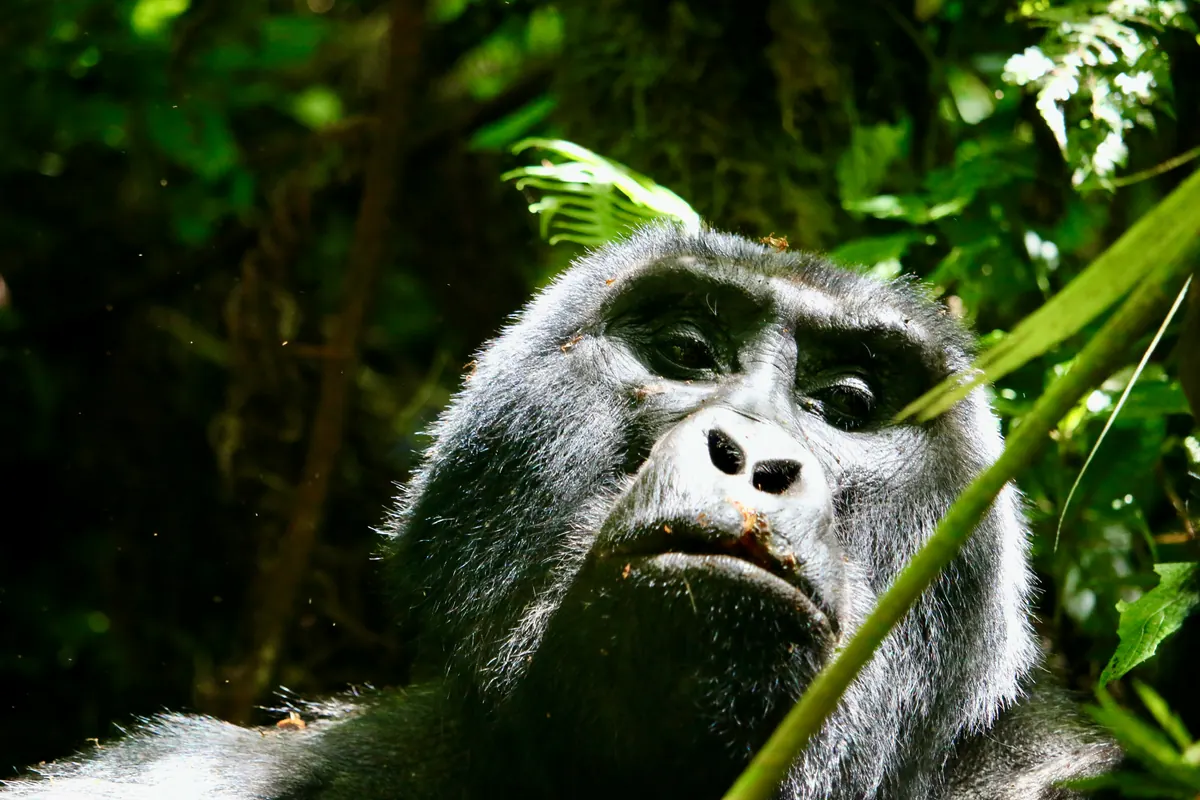
Uganda’s primate permits are the most expensive single line on an East African itinerary, and in 2026 the rules for them changed twice: a new low-season rate, and an end to holding permits without paying. A third change, a revised tariff, takes effect on 1 January 2027.
Much of what ranks for these questions repeats a wrong effective date. Everything below is taken from two Uganda Wildlife Authority documents: the UWA Conservation Tariff 2024–2026 and UWA’s stakeholder letter of 26 February 2026 (ref. TDO 93/04).
What does a gorilla permit cost in Uganda?
UWA prices by visitor category. From the 2024–2026 tariff, for gorilla tracking in Bwindi Impenetrable and Mgahinga Gorilla national parks:
| Category | Gorilla tracking | Gorilla habituation |
|---|---|---|
| Foreign non-resident (FNR) | USD 800 | USD 1,500 |
| Foreign resident (FR) | USD 700 | USD 1,000 |
| Rest of Africa (ROA) | USD 500 | USD 1,000 |
| East African (EAC) | UGX 300,000 | UGX 750,000 |
The permit rate includes the guide fee, park entrance for that day and a community development contribution. Tracking is limited to eight visitors per gorilla group and one hour with the gorillas. The minimum age is 15.
What is the new low-season rate?
UWA’s 26 February 2026 letter introduced discounted permits for April, May and November, effective immediately:
- Gorilla tracking: USD 600 foreign non-resident, USD 500 foreign resident
- Chimpanzee tracking: USD 200 foreign non-resident, USD 150 foreign resident
The condition that matters for an operator is in the same sentence: low-season permits cannot be rescheduled. A standard permit that is rescheduled late costs a fine of 25% of the permit fee under the tariff. A low-season permit has no reschedule option at all. If you sell the cheaper month, your booking terms should say that a date change is not possible for that permit.
What changes on 1 January 2027?
The same letter sets a revised tariff from 1 January 2027. Several widely shared articles give a mid-2026 date for this. The UWA letter says 1 January 2027.
| Activity | FNR | FR | ROA | EAC |
|---|---|---|---|---|
| Gorilla tracking | USD 800 | USD 700 | USD 500 | UGX 300,000 |
| Gorilla habituation | USD 1,800 | USD 1,600 | USD 1,000 | UGX 750,000 |
| Chimpanzee tracking (Kibale) | USD 300 | USD 200 | USD 100 | UGX 180,000 |
| Chimpanzee habituation | USD 400 | USD 300 | USD 250 | UGX 250,000 |
| Chimpanzee tracking (Kyambura) | USD 200 | USD 150 | USD 100 | UGX 50,000 |
| Experiential lion tracking | USD 500 | USD 300 | USD 300 | UGX 250,000 |
| Golden cat tracking (Kibale, 5 days) | USD 350 | USD 350 | USD 350 | UGX 350,000 |
Gorilla tracking itself does not move. The increases fall on habituation and chimpanzees. Kibale chimp tracking goes from USD 250 to USD 300 for non-residents, and gorilla habituation from USD 1,500 to USD 1,800. Any quote you send now for a 2027 departure that includes those activities should be priced on the 2027 table.
Why does the end of the 7-day reservation matter?
Until 1 March 2026, UWA’s booking system let operators reserve permits for up to seven days without paying, then cancelled unpaid reservations automatically. UWA suspended that window from 1 March 2026. A permit is now secured only by full payment at the time of booking.
For an operator, that turns the permit into an upfront cash cost. You can no longer hold a date while the client decides and pay later. To secure the date, you pay the full USD 800 per person. So the client’s deposit needs to cover the permits at least. Collecting a deposit smaller than the permit value means funding the difference yourself until the balance arrives.
UWA’s tariff also rules out the “book it yourself” shortcut for most clients: gorilla and chimpanzee permits for foreign non-residents and rest-of-Africa visitors can only be booked through licensed tour operators.
How do you pay UWA?
The tariff lists mobile money (Airtel Money Pay and MTN MoMo Pay), card payment at point of sale, bank transfer, direct bank transactions and UWA’s online payment portal.
How do you build permits into a costing?
A permit line is travellers × permits × the rate for their category and month:
- Two foreign non-resident clients tracking gorillas in November: 2 × USD 600 = USD 1,200.
- The same two clients in October: 2 × USD 800 = USD 1,600.
That USD 400 difference is why permits need their own line per activity and date in your tour costing sheet, rather than being folded into a package price. Two more rules keep the line accurate:
- Don’t double-charge park entrance on the tracking day. The gorilla permit already includes that day’s entrance. Other days in the park are charged separately at USD 40 per foreign non-resident adult (Bwindi and Mgahinga are Category A parks). An entrance ticket is valid for 24 hours, and extra time is charged as another day.
- Kibale chimp tracking includes entrance. Kyambura chimp tracking does not.
Like the Kenya park fees, the category assumption (non-resident, resident, rest of Africa, East African) belongs on the quote. It changes the price by hundreds of dollars per traveller. A clear quote also states whether a low-season permit is included, because the no-reschedule rule becomes the client’s constraint too.
UWA’s tariff notes that fees are subject to change without prior notice. Confirm the rate at payment, which since March 2026 is also the moment of booking.